Reginald Marion “Pop” Merrill
Needful ThingsReginald Marion “Pop” Merrill is a Castle Rock moneylender whose refusal to bankroll his nephew’s cocaine business and whose peculiar posthumous clues drive Ace Merrill’s search for wealth. Though town gossip casts Pop as a miser with a fortune, the evidence Ace uncovers is far less straightforward: a small bank balance, obsolete trading stamps, and a map marked with crosses that may point to buried money.
Identity and Reputation
Pop had lent money to half the people in town and was reputed to be rolling in dough. To Ace, who was short of funds, that reputation and their family tie made a loan seem reasonable. Pop, however, did not treat kinship as an obligation to support his nephew. His reputation for wealth therefore coexists with a sharp refusal to turn that wealth into assistance for Ace.
The refusal is grounded in Pop’s judgment of how Ace makes his money. He identifies cocaine as the source and notices a trace of it on Ace’s nose, treating that visible carelessness as evidence of the danger in Ace’s trade. Pop warns that users and dealers end up in prison or dead, and explains that he will not lend money to someone who may be unable to repay him. His bluntness makes the warning less a general sermon than a creditor’s calculation: the borrower’s criminal risks threaten the lender’s ability to collect.
The Loan Refusal and Its Consequence
Ace remembers asking Pop for a loan during one of his financial embarrassments, after he had joined the Connecticut Corson brothers in dealing both firearms and cocaine. Pop’s rejection becomes a formative detail in Ace’s account of their relationship: Ace believes he should qualify because he is young, has prospects, and is family, while Pop sees a dangerous borrower whose money comes from cocaine.
The episode precedes Ace’s imprisonment. Not long after Pop warns him about the possibility of doing time, Sheriff Alan Pangborn catches Ace and two associates trying to break into the safe in Henry Beaufort’s office at The Mellow Tiger. The attempted-robbery charge is dropped in a plea bargain, but Ace receives a substantial sentence for nighttime breaking and entering and is in Shawshank less than four months after Pop’s warning. The sequence gives Pop’s warning a grimly exact consequence, even though the arrest is for a separate crime rather than the drug dealing Pop describes.
The Book and the Inheritance Puzzle
After Pop’s death, a book displayed in the window of Needful Things draws Ace inside. Its cover shows two silhouetted men on a nighttime ridge, one carrying a pick and the other a shovel, apparently digging. The title, Lost and Buried Treasures of New England, is printed above Pop’s name as author. The book makes Pop’s name a clue: Ace is not merely trying to borrow from a wealthy relative but confronting the possibility that Pop left a trail to wealth he concealed.
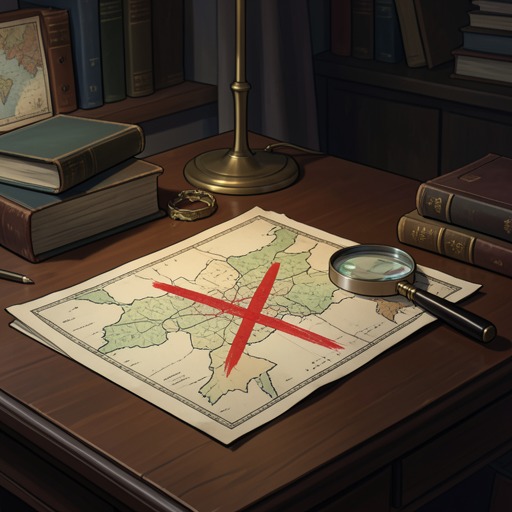
The trail becomes more specific when Ace studies a map and notices its crosses. He counts seven, then realizes there are eight. One appears to mark swamp ground once owned by Treblehorn, who has been dead for years; Ace recalls talk that Pop acquired most of that land as repayment of a loan. Other crosses lie near the Nature Conservancy beyond Castle View, along Town Road No. 3 near the old Camber place, Seven Oaks Farm, and on land supposedly owned by Diamond Match west of Castle Lake. The scattered locations connect Pop’s lending history and property dealings to the possibility of hidden money, but the map does not itself confirm what lies at any site.
Death, Money, and Ambiguity
Ace’s expectation of an inheritance has already been frustrated by the estate’s apparent contents. He says that Pop left him no money: there was less than four thousand dollars in Pop’s bank accounts, and that sum went toward the burial and the cleanup of a mess Pop left downtown. When the safe-deposit box was opened, it contained six books of Plaid Stamps and fourteen of Gold Bond Stamps. Ace stresses that Gold Bond Stamps could no longer be redeemed because the company had gone out of business. What appears to be a record of thrift or accumulated value therefore yields little usable wealth.
That disappointment sharpens the contrast between Pop’s public image and the remains Ace can verify. The town’s belief that Pop had retained every dime he ever earned does not match the small account balance and the worthless stamps. Yet the book and map preserve another possibility: Pop may have hidden money rather than left it in conventional accounts. The evidence leaves the question open, making Pop’s legacy less a settled inheritance than a riddle Ace must interpret—and a possible lure toward the locations marked on the map.